
Quality and type testing: how industrial equipment proves itself
Every serious industrial tender contains a clause that separates manufacturers from assemblers: the list of tests the equipment must pass before it ships. Type tests prove the design, routine tests prove the individual unit, and the gap between the two is where most vendor qualification disputes live. This article walks through how testing is organized inside a heavy electrical group and what a buyer should actually ask to see.
Type tests versus routine tests: the difference that matters
A type test is done once, on a representative unit, to validate the design against a standard — IEC 60076 for power transformers, IEC 60034 for rotating machines, IEC 62271 for switchgear. It includes the brutal stuff: lightning impulse, short-circuit withstand, temperature rise at full load. A routine test is done on every unit that leaves the works: insulation resistance, winding resistance, no-load and load losses, functional checks of protection circuits.
The practical rule for a buyer: routine test certificates travel with the equipment, type test reports are referenced by design. If a vendor offers a "type test report" that is twelve years old and covers a different frame size, that is a negotiation point, not a certificate.
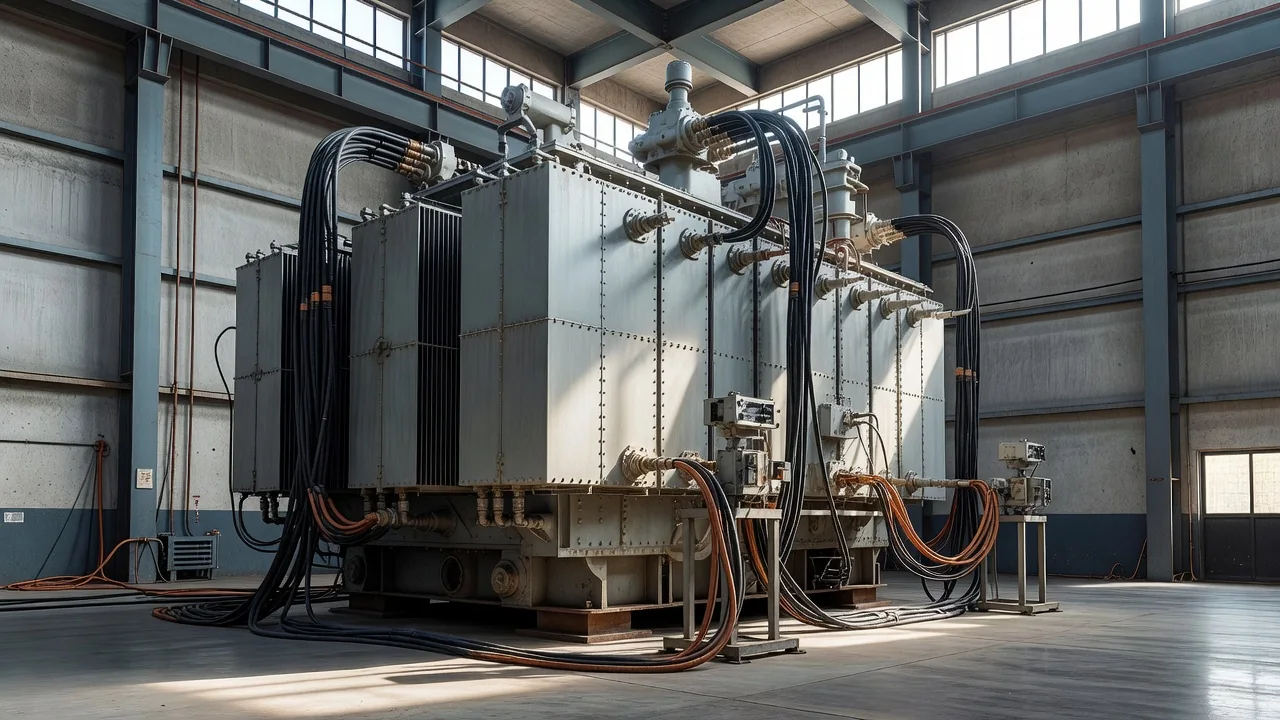
What the test bays can actually do
Large works maintain their own high-voltage laboratories, impulse generators and load-back facilities. A transformer works can run heat-run tests by loading two units back to back; a machine works runs motors on dynamometers; the electronics division burns in drive panels on aging racks for 48 to 72 hours before dispatch. These in-house facilities are why established manufacturers can offer witnessed routine tests without renting external labs.
Special tests are a different story. Short-circuit withstand tests on large transformers go to external stations like CPRI in Bengaluru or ERDA in Vadodara, because no factory keeps a grid strong enough to short-circuit a 315 MVA unit. When a tender demands a special test, the schedule and cost of the external lab belong in the delivery plan.
Worth knowing: external labs book their slots weeks ahead, and a failed attempt means re-queuing with the unit still on the lab floor. Contracts that pass the special-test risk to the vendor without a schedule buffer transfer a delay the vendor cannot fully control. The fair clause shares it: the vendor books the slot promptly, the buyer accepts the lab's queue as excusable time.
| Test category | Examples | Frequency |
|---|---|---|
| Type test | Lightning impulse, temperature rise, short-circuit withstand | Once per design |
| Routine test | Insulation resistance, losses, ratio and vector group | Every manufactured unit |
| Special test | Sound level, partial discharge beyond standard limits | On demand, per contract |
| Site acceptance test | Protection trip checks, functional sequences | After erection, before handover |
Quality plans and hold points
Between the purchase order and the test bay sits the quality plan: a document that lists every manufacturing and inspection step, the responsible party and the hold points where work stops until an inspector signs. A typical transformer quality plan has hold points at core assembly, tanking and final tests. The buyer's inspector — own engineer or a third party like TÜV, SGS or BV — witnesses these steps against the approved plan.
Vendors who treat the quality plan as paperwork discover its teeth at the hold points. Work done past a hold point without a waiver letter can be ordered redone, and the schedule damage belongs to the vendor. The waiver letter itself must come from the buyer's quality desk, not from a phone call with a site engineer.
- Approve the quality plan before manufacturing starts, not during it.
- Match each hold point to a named inspector and a notice period, usually 7 to 14 days.
- Keep witnessed test certificates indexed by equipment serial number.
- Photograph nameplates before dispatch; disputes about ratings start there.
Certifications and what they do not prove
ISO 9001 certification of the works is a baseline, not a product guarantee. It says the processes are documented and audited; it does not say your specific unit passed its heat run. The documents that protect a buyer are the routine test certificate for the serial number delivered, the type test report for the exact design, and the calibration certificates of the instruments used. A megger with an expired calibration sticker can invalidate a morning of test results.
Risks and red flags at inspection stage
The oldest trick in the book is the borrowed test report: a certificate from a similar machine presented as proof for the quoted one. Check the frame size, the date and the lab that issued it. The second trap is schedule compression that eats test time — a vendor who offers delivery "two weeks early" may be planning to skip the burn-in. Finally, be careful with tests waived to save time: a waived routine test today becomes an unexplained trip six months after commissioning, and warranty arguments without baseline data are the ones buyers lose.
Testing is the one stage where paper and physics must agree. Insist that they do.